We have visited several historical sites during our travels, and so also on this route.
One of the first Inca settlements we visited where in Tilcara, Argentina. We jumped on a short, guided tour (guided by a young indigenous man) who told his story and took us through a brief and well-presented narrative of the history of the Inca empire. Interestingly, his presentation opened for questions by the participants and a discussion of history as a political- and cultural and religious power process, not hiding that the history as told from a European perspective is not the only one. After all history is an interpretative science (something we are acutely aware of these days both in Ukraine and in Gaza) often reported and documented with the political gain of satisfying the most powerful. A process in which communicative oral and written skills, often combined with administrative resources, and religious- and cultural influences play important roles. But interestingly history is also dynamic and can be methodologically revisited and reinterpreted – we can still learn from past errors and gain new wisdom. Or can we? Maybe we should ask Putin, Milei or Trump… or any other politician.
The next big Inca settlement we visited was at Ollantaytambo where we asked permission to camp for one night in the tourist bus parking lot. The historic site was very impressive, and we negotiated a 1-hour lecture on the site before walking through it on foot. Built during the time-period of the reign of the Nordic Vikings, the constructions are impressive using huge blocks of stone which have been transported overland from open mines many km away. The dedication and motivation, in addition to the physical skill (in terms of transporting, lifting and building with these huge stones) and architectural competence, is just incredible. But there it is, as proof of an advanced civilization at the time of early medieval age in Europe. We all know at which societal level; degree of civism and social organization we Europeans were at the same time… But still we have as the most powerful written or influenced the writing of much of history. It’s a fact interesting to reflect on (and sitting behind the steering wheel I had plenty of time).
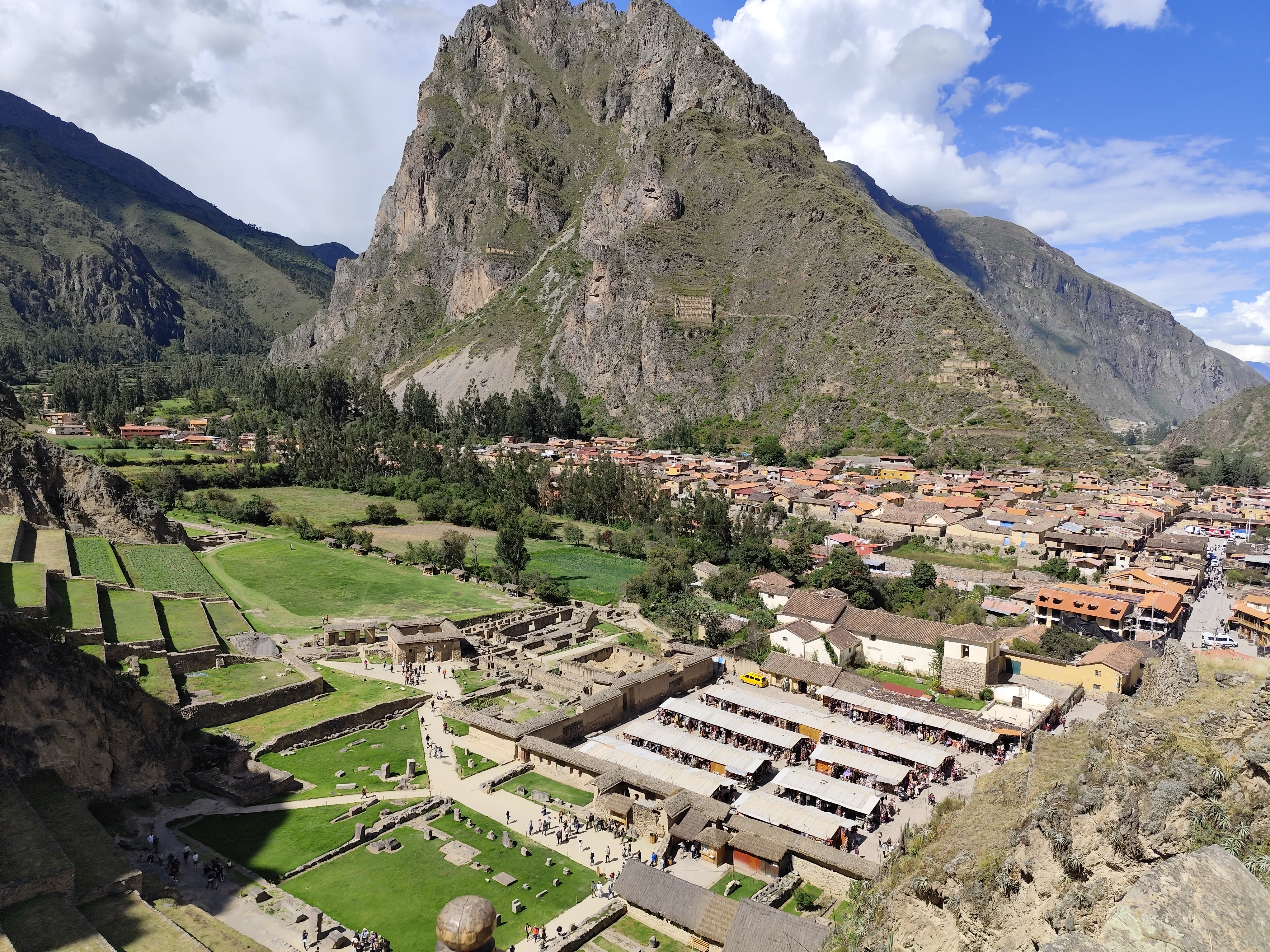
I was again left with a feeling that the indigenous guide, somehow told us a premeditated historic tale she had been told to give us – we were given a narrative with an apparent low degree of personal (Inca and native) ownership and somewhat surprisingly without attempts of giving a particular “indigenous twist” or taking advantage of the opportunity to tell visitors a slightly alternative and native perspective of the normally accepted history we commonly are taught…. At least in most European school systems. For sure, any story or history has more than one interpretation.
As we continued to travel through Peru’s sacred valley north of Cusco, this phenomenon repeated itself – guided tours (and frankly we did not participate in many) were, with some honorable exceptions, often a recital of facts learned by heart. A little weird, but maybe the guides, often indigenous, deliver what they are told “tourists” want to hear – because naturally you prefer to hear what you expect to hear. Anything else, would likely distort your preexisting general understanding of past events? But isn’t that what learning and sightseeing are all about – gaining new insights and alternative perspectives on past events?
After all, and possibly somewhat out of the context, maybe President Petro of Colombia is onto something – by giving the people on the lower stiles on the social ladder a voice? Thus, opening for a more nuanced presentation of history as well as the future? Of course, one may question the choice of (sometimes) inflammatory rhetoric, but the struggle between the rich and poor, the right of landownership, affordable healthcare and distribution of resources are relevant. As relevant in the Americas as in many other countries.











 elworldtrip
Posted on April 2, 2025 by oyvinkyvik
0